Showing posts with label blog. Show all posts

Monday, February 4, 2013

The Pravachan Jitters

Our scriptures note the particular significance of mantra-jap in its ability to steady our mind, yet the mantra of syllables we utter when nerves compromise our ability to communicate does anything but strengthen our resolve.

Photo Credit: andres.thor via Compfight cc

Stuttering stands to dilute a sticky message but can be reigned thanks to a few tips shared by an article on Duarte:
  1. Visualize Something Positive. Visualizing something that makes you happy is known to help you relax and thereby reduce stuttering. Imagine something that you love is in the room with you, or even keep a picture of something you love on the podium, or in your pocket. I’ve seen great speakers keep images of their children on their teleprompter because of this technique.
  2. Get Familiar. To this day, I visit a venue a few days before a show. I’ll soak in the details and reduce future distractions that can cause my mind to wander. I don’t know if it’s ADD, but I get those “Ooh shiny object!” moments when performing, and I seem to stutter after those distractions occur. So I try to familiarize myself with my surroundings, and if possible, rehearse in the venue so that it becomes second nature. This familiarity reduces heart rate and irregular breathing which are muscular triggers that can lead to stuttering.
  3. Rehearse, Rehearse, Rehearse. My professor used to tell us to rehearse our lines in a dark, quiet room, laying on our backs. This forces you to focus only on your voice and what you’re saying. Sometimes when I present, I’ll wear earplugs so that I can hear my voice, and focus on my projection and articulation. Perhaps you can’t memorize your whole presentation, but I would suggest rehearsing your opening and closing with this technique.
  4. Take a Deep Breath, or a Lot of Them. Before you go on stage, focus on the pace of your breathing until you can slow it down and reduce your heart rate. Once I get a controlled rate of breathing, I try to be conscious of it when I’m on stage. If not, the adrenaline kicks in, my heart races, and I talk so fast that no one can understand me.
  5. Pace Yourself. I mean actually pace – move around a bit onstage. A slow, steady walk across the stage can set a rhythm, that will help slow down your thinking and your speech, and reduce the confusion that often leads to stuttering. My instructor once made me recite four pages of a play while walking around the campus with her. I didn’t stutter once! But when I stood still on a stage in front of a large group, I stuttered and mumbled like a madman. The pace of my walking helped control the mechanics of it all.
  6. Get Some Sleep. For a long time, I tried cramming lines and content up the last minute of the performance. Staying up all night rehearsing and memorizing. I was a wreck. My professor told me, “Rehearse and study, but the night before, sleep, a lot!”
Let's face it, nobody likes to panic before a pravachan, but when we introspect, we realize the angst stems from whether or not we will defy the audience's expectations.

Ambition - now that's something worth contemplation.

Saturday, June 30, 2012

Seize the Shibir

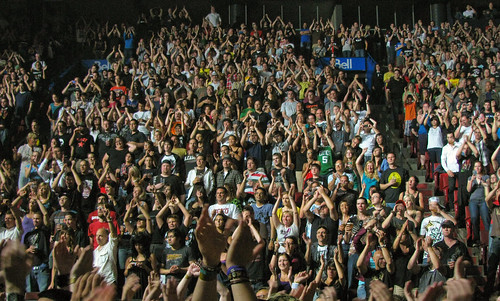
Green Day Concert Crowd - Put Your Hands Up For Green Day


Bill Clinton, Lady Gaga, and Chris Rock all have one thing in common - they know how to work a crowd, and we can too at a shibir or a convention! 

Sure, it’s a larger audience, but to be an effective shibir speaker, we will have to do a few things different from what we already do on a Sunday-to-Sunday basis. Aside from a larger audience, we have a new setting, a new microphone, and new faces in the crowd.

As always, we will need to do our SUS in order to to give our talk meaning, but an article at Lifehacker gave us a few more pointers:

Know Your Environment: Presentations always start with knowing the environment. How many people will be there? Am I presenting to K1, K2, Kindergarteners, or 8th graders? Will I have a screen? Remember, you, the presenter, are responsible for getting the message across to the audience. Therefore, don’t be afraid to make a simple request in order to make your presentation flow smoothly.

Body Language: Every Sunday, we have the chance to have one-to-one eye contact with every single person in the room. When talking to a bigger crowd, eye contact is still important though much harder. Therefore, we have to be strategic. Break down the audience into different blocks, and work with each of the blocks one at a time. Imagining the audience as a huge mass will make it harder for you to develop a connection with your crowd.

Keep it Simple: Try to avoid using a large amount of special effects in the presentation. Don’t sacrifice clarity for animations, sounds, and/or background images. Even if we’re using PowerPoint, it’s best to keep the slides straightforward and clean.

Interactivity: Without being a afternoon talk-show host, there are certainly ways that we can connect with our audience at shibirs. Because there is a large audience, things might get tricky when we’re trying to get interactive, but we can always create exercises to make it happen by asking the audience to do any of the following.
  • "Turn to the person on your left and talk about..."
  • "Write 3 things on your sticky note that..."
  • "Raise your hand if..."
  • "Rub your tummy, stomp your feet, etc." (for bal mandal of course)
Getting out from behind the podium is also another way to connect with the audience as well as getting a wireless mic to ask the audience questions to get interaction. Of course, we would be wise to avoid frivolous inquiry like, "Who is the President?" "What is agna?" "Who can define raajipo?" 


All in all, a shibir talk just requires a modified approach that would not be possible without the basic understanding of a Sunday talk, for only after captivating a sabha audience can we hope to hold a shibir audience. 

Friday, May 18, 2012

The Wadsworth Constant: Ignore 30% of Everything

Lone Gunman reveals to us an interesting strategy for speech writing:

Last year Steve Yegge wrote about life at Amazon.com and what it’s like work­ing under Jeff Bezos. On the topic of pre­sent­ing to Bezos, Yegge gave this tip: delete every third para­graph.  Why?
Bezos is so god­damned smart that you have to turn it into a game for him or he’ll be bored and annoyed with you. That was my first real­iza­tion about him. […]
So you have to start tear­ing out whole para­graphs, or even pages, to make it inter­est­ing for him. He will fill in the gaps him­self with­out miss­ing a beat. And his brain will have less time to get annoyed with the slow pace of your brain.

Around the same time as Yegge’s post­ing, a Red­dit user known as Wadsworth pointed out that the first 30% of “nearly every video in the uni­verse” can safely be skipped. As such things go, this soon became a YouTube URL para­me­ter: just add &wadsworth=1 to skip the first third of the video.
This ‘law’ soon became known as the Wadsworth Con­stant. It works.

What does this imply for the sabha.ologist? It seems as if we could safely sleep through 30% of presentations, so the deeper meaning is that when giving a talk don't be stingy with the editors knife.

Get rid of 30% of your matter and refine the rest to make it stick.

Saturday, May 12, 2012

The Speaker's Samjan

2-Way Traffic


We've noted the benefits of speaking before, and a recent PsyBlog article adds another.
Janis and King (1954) tested this by having some participants give a talk while two others listened. Then they swapped around and one of the passive listeners gave a talk to the other two on a different topic. 
What emerged was that, on average, people were more convinced by the talk when they gave it themselves than when they merely heard it passively. This suggests that we really are persuaded more strongly when we make the argument ourselves, even if it isn't in line with our own viewpoint. 
The same trick works with attitudes to smoking. People are more put off smoking when they deliver an anti-smoking message than when they passively receive it (research described in Brinol et al., 2012). 
We see the same effect for self-confidence. When people are told to present themselves in a self-confident way to others, they actually feel more self-confident themselves.
Not only does an effective presentation empower an audience, it exerts an equally powerful effect on us as the speaker. We must call forth our faith in order to deliver to others a case for our faith, so in the moment preceding our time to open our talk in sabha, let's appreciate how we've taken one step closer to goal we wish to communicate passionately.

Wednesday, February 1, 2012

Unconventional Advice

Every so often, we stumble upon some unorthodoxy that has the potential to shake up our speaking for the better, like this recent LifeHacker article.

    All I want for Christmas is a 2 dimensional reduction
  • Dribble Twice, Spin Once: Basketball fans will recognize the pre-shot patterns of basketball players to better focus themselves. Preceding our presentation, a similar routine can help shake some nerves and build confidence.
  • Death to Powerpoint: Slides often stymie our natural ability to express ourselves, so use Powerpoint with discretion.
  • Speak to Two People: Eye contact can rattle the new speaker, but focusing on two people in the room keeps things in perspective.
  • Embace Your Ums: Focus on your natural storytelling ability, and the audience will seemingly gloss over those pesky words.
  • Don't Memorize: Rehearsing can help us develop our flow, but memorization just renders us mechanical and inorganic.
  • Practice with Live Ammunition: Set yourself to speak publicly to capture a true simulation. With practice, we can feel accustomed to this arena and excel.
Twist things up with these tidbits of advice, and let us know how they end up working out!

Saturday, December 31, 2011

Persist with Poise

As 2011 draws to a close and a new year awaits with many more chances to chisel our speaking/presentation skills, we thought it would be worth it to end on a note of perseverance by Seth Godin.
Insulate yourself...
from anonymous angry people
Expose yourself to art you don't yet understand
Precisely measure the results that are important to you
Stay blind to the metrics that don't matter
Fail often
Ship
Lead, don't manage so much
Seek out uncomfortable situations
Make an impact on the people who matter to you
Be better at your baseline skills than anyone else
Copyedit less, invent more
Give more speeches
Ignore unsolicited advice
Making sabha better requires a delicate, piecemeal approach, so let's start with the right attitude in 2012.

After all, what better way to start it off with Sunday sabha?

Saturday, December 24, 2011

Elevator speeches don't make you Brahmrup

Seth Godin shares this nugget of insight:
No one ever bought anything in an elevator 
The purpose of an elevator pitch isn't to close the sale. 
The goal isn't even to give a short, accurate, Wikipedia-standard description of you or your project. 
And the idea of using vacuous, vague words to craft a bland mission statement is dumb. 
No, the purpose of an elevator pitch is to describe a situation or solution so compelling that the person you're with wants to hear more even after the elevator ride is over.
Similarly, nobody takes away a sticky message by just listening to the shakeup (unexpected) part of a talk. The unexpected sets up the talk, piques attention, but if there are no stories without concrete and credible, everyone will just get off the elevator.

Wednesday, December 7, 2011

Designing Slides

Corso Presentazioni EfficaciBullets, borders, boxes: the three B's of slide design. Throw in one more: boring!

A fellow Sabhaologist sent in this article by Zach Holman that highlights a few principles to accentuate our presentation. His slides wowed the audience so much that after his talk, his slides got voted #1 on Hacker News

Zach notes, "Working on your slide design pays off for the audience in front of you and for the audience online reading your slides later. I learned a lot designing this talk, and I think it can be helpful for you, too."
  • Color: "Color is the very first thing people will notice. It should also be the very first thing you think about." Use lighter shades to accentuate darker shades (e.g. light blue & dark blue).
  • Size: Zach's slide deck averages 150pt with 300pt or more on the high end or 90pt on the low end. Go big or go home.
  • Words: "Letters themselves can be part of the design." Thus, Zach's slides will shake up the size from slide to slide to emphasize different elements - an application of unexpectedness.
  • Repetition: "The best storytellers will repeat the same line throughout a story to build a sense of familiarity, of excitement...Steve Jobs did this often. Before moving onto the next product announcement, he’d spend thirty seconds and go over the same information he just presented. It’s a very simple way of keeping things memorable for your audience." Zach starts each section with colorful, bold text on bright, orange backgrounds.
With Powerpoint's assortment of templates, designing slides seems like such a waste of time, yet if the audience finds our slides a waste of their time, our message is lost.

Maximize their time by creating slides with craft and care.

Saturday, August 6, 2011

The Wrong Body Language

A fellow Sabhaologist sent us this nifty article that summarizes the no-no's when it comes to our posture and position amidst speaking and presenting. Though in each of our mandals we have a slightly different setup for sabha, it may not hurt to remember these annoying habits to stay on the good side of audience perhaps even in a non-mandir setting.

Tapping a Pencil

After all, it's great to captivate the audience but not at the cost of composure. 

Friday, May 20, 2011

Authentic Speaking

For the past few months, we've seen what it takes to make a powerful presentation
  1. Simple statement
  2. Shakeup
  3. Stories
So we go to the drawing board every week in crafting our message, do a quick practice, and then execute on Sunday... only to see little enthusiasm in the audience.

What gives? Maybe there's something wrong with them. Maybe there's something we're not doing.

The Calm After the Show

Body language is the doing that goes with the talking, and without it, our presentation may have a powerful message but will also appear artificial. 

Fear not, for communication Dr. Nick Morgan is here to help. In a recent article, he suggests we focus the following four aims.
  • Being open to the audience: Imagine what it's like to give this speech to someone you're comfortable with; it could even be Pramukh Swami Maharaj if we've had that opportunity. Focus on making that your demeanor prior to presenting.
  • Connecting with the audience: Let's picture ourselves trying to talk to a balak who isn't being all too attentive. Do we need to think to try to capture his attention? Not quite. We do what feels natural, like raising our voice or moving closer. That's the natural touch we should have in our presentations.
  • Being passionate about the topic: Think about what's at stake with this presentation and what results we want our presentation to deliver. We want our audience to grow closer to our guru, and if we genuinely feel it, it will come through in word after word of our delivery.
  • "Listening" to the audience: If it's sabha, we know what people expect with different individuals who are assigned to present. What do people expect as we present - a quick nap or a quick burst of energy? By picking up on nonverbal cues in the audience, we can maximize our delivery through changing up our delivery, asking an impromptu question, or adding/removing parts of our talk.
In short, let's try to keep these four principles in mind as we go up to present, be in sabha, shibir, or school. These finer points will inevitably come in handy.

Friday, October 29, 2010

Sabha Presentations that Knock Your Socks Off

The path to a stickier sabha can be long, tiring, and even exhausting - that is if we fail to take note of the signs along the way. So this week, let's take a moment to pause and reflect on some advice adapted from an article entitled, "How to Prepare Public Presentations that Knock the Socks Off," to develop that shock & awe atmosphere in sabha.


Nail the Benefit
In other words, how will this presentation benefit the audience? Yes, "to please Maharaj & Swami" or "to get moksha," is part of it, but let's think a bit more deeply. For instance, learning about kusang can help my K2 mandal focus on their academics which can contribute to a successful career which of course will then please Maharaj and Swami. In short, take a few moments to connect the dots for ourselves before we expect our audience to do the same; we may do it subconsciously, but our target audience may not.


Create a Memorable Structure
Remember that one time when we went up to speak and we just went blank? We can easily make sure that does not happen again with a little bit of structure. 

The article states, "A structure that storytellers have used since ancient times is the three-act form. In the design of your presentation, Act 1 is the opening. It is the description of the pain points, challenges, and frustration that your audience faces in respect of your topic. When you promise to show how to overcome these challenges in order to reach a desired outcome, you sets up a dramatic tension.

The corresponding part of your presentation is Act 3. It offers the resolution, and describes how one is changed and rewarded through overcoming the challenges and attaining the desired outcome.

Act 2 is the detailed description of the path from A to B. It is the ‘how to’ section of the presentation.

No matter what your topic is, this structure ensures that you connect with your audience, because people feel understood when you name their pain, and inspired when you show them how to overcome it.  This three-act structure ensures dramatic tension and release – which you need in order to create a memorable presentation."

What is the Story Thread?
Along the lines of structure, a metaphor or analogy can often enhance the message at hand. In fact, pay attention to the next pravachan given by a P. Sant; one of these threads

A few examples mentioned in the article are listed below.
  • Climbing a mountain: how someone overcomes all difficulties to reach the summit.
  • Finding the missing piece of a puzzle: how a search is finally rewarded with a new insight into how pieces fit together.
  • Voyage into the unknown: how an adventurer set out into the unknown and finds a place hitherto unknown.
  • The treasure hunt: how someone follows hidden clues and finally uncovers a treasure.
  • The reluctant hero: how an ordinary person overcomes all odds and ends up a hero.
  • Finding the source: how someone walked back in order to find the source or origin.
  • The blockbuster story: you can use a story thread from popular literary pieces, like Lord of the Rings or Harry Potter. 


The Architecture
So we've gathered a good number of elements, but let's put them to use through a three-part structure.

Opening: "Your first task is get your audience’s attention and to create a connection. A great way to do this is to relate a personal story, the ‘why’ of your presentation. Why are you passionate about this topic? How does this topic relate to your life? If you lead in with a personal story, it’s much easier for people to relate to your topic. And your personal story establishes authority. In order to grab your audience’s attention, see if you can start in a way that’s unexpected.

Let’s say you are going to present a talk on how to become a runner, in order to go from flab to fit. Your opening could be your story about how you were overweight, and then managed to become slim and fit by taking up running. Once you’ve established your motivation and authority, it’s time to start with Act 1, that is, you need to speak about people’s pain, frustration and barriers in respect of your topic. The pain points here could be feeling unattractive, unhealthy, or unfit. The challenge could be the beliefs that ‘I could never learn to run’, or ‘I get puffed after only a few meters – how could I ever get fit?’

The desired outcome (that’s going to be Act 3 of your presentation) is to become a runner in only 5 weeks ‘by using the following 5 step body-control program’.  In this scenario you would need to spend a moment explaining why the ‘5 step body-control program’ is effective. Then it’s time for the development phase."

Development: "This is the phase where you lay out exactly how to overcome the pain points in order to reach the desired outcome. The brain learns best if you offer bite-sized bits of information. This is why numbered steps or bullet-points work so well. This is going to be the ‘meat in the sandwich’, so to speak. The development part of your presentation should be the longest part with detailed information. Once you have laid out how to achieve the desired outcome, it’s time for the closing.

Conclusion: "In the closure it’s time to talk about how it feels when you achieve the benefits. Maybe you can give examples of others who also achieved success in order to inspire and motivate. It’s a good idea to repeat briefly the main steps of your development phase. In other words, you need to remind them briefly of the main content of your presentation.

Then comes the call to action.  You need to outline the next step for your listeners. What should they do now in order to move closer to the desired outcome? Are there special resources they can access? Is there an action they can do today that will start them on a new path?"

To PowerPoint or Not?
Through shibir and sabha, perhaps we've seen the triumph and fail of Powerpoint, which makes its use all the more an appropriate issue to consider. "Most presenters these days use PowerPoint slides. That can be very effective. Because you can use images and motion in order to hammer home your points. I think in general, PowerPoint presentations are great if you want to convey information.

However, if your presentation revolves is inspirational and revolves around your personal story, then just words may well work better because such a presentation is more intimate.

Whether or not you use PowerPoint, it’s important for your presentation to sound like your talking, and not reading aloud."

The article even suggests two books worthy of checking out.


Conversational Tone
Reading the syllabus does a lot to bring down our speaking and presentation style. It's a resource and definitely not the final product. Why?

"The best presentation are conversational. Even if you’ve worked them out to the letter, they still need to sound spontaneous."

Unless we ourselves wrote the syllabus, it's does not sound like us, so it's best to reframe and rephrase it in our own words. Then, "read aloud your draft to others. Whenever you notice that a sentence sounds contrived, mark it for further work. What often works is to shorten sentences, use simple language and use contractions, such as ‘you’ll’ instead of ‘you will’. These rehearsals are a key part of building confidence."

For more help, check out the linked article below.

Timing
Nothing kills it more for the audience then a presenter who does now know when to stop. Every mandir has that one person - be it a karyakar or that kishore - and to avoid any buzzkill, it's best to stay within the time limit. "Each presentation usually has a timeframe that you need to adhere to – especially if you invite questions at the end. Make sure you time your rehearsals. Then cut your text so that you spend only 80% of the allotted time, in order to have some time up your sleeve."

Conclusion
In short, structure and planning can only add to our sabha cred, so let's not underestimate its importance the next time we go up to speak. After all, it can make our presentation memorable.

For further reading, check out, "How to Speak in Public With Confidence – And Be On Top of Your Game."

Friday, February 26, 2010

Perfect your Presentation - Get rid of slides randomly?


[This is another guest post by a reader who as been there from the very beginning - about two months ago. You too can send a guest post hit up the comment links below.]

This fits in with the post about Gladwell writing out his entire talk and then memorizing. He basically practices a lot before speaking. The following tip came from LifeHacker and was written by Alex Croft. His overall idea is that if you know your talk well then if something goes wrong you can still make the talk stick. His intuition is to practice this by having someone remove a random slide (or note card) form your presentation - can you still get through it without going through the Uhhh ohh Umm - or giving the AV guys the Neck Crane? (Seriously if you don't now what the Neck Crane is you need to click on that previous link). We have all been there where the video will not play on the powerpoint, or that codec which you tested a hundred times before the talk will not work, or the mic go off - but if you practice it ahead of time you can make it stick.

I was at a microbiology seminar this afternoon where a researcher was giving a presentation via PowerPoint. After a few slides a crucial diagram failed to show up over the projector. I would have gotten flustered and cursed the Microsoft Office for Mac gods. This presenter didn't though. She just walked over to a nearby whiteboard and drew out the entire diagram from start to finish, explaining as she went along. This turned out to be a much more effective way to describe her system than even a perfectly constructed PowerPoint slide ever could. Even more effective? Everyone was impressed how well this presenter knew her stuff—it was a very complex diagram.

It's one thing to follow something already on a PowerPoint slide. It's another to recall it completely from memory under pressure and technical malfunction.

This got me thinking. A spectacular way to practice a PowerPoint presentation would be to have someone eliminate one of your slides, or a section of a slide. Then, run through that altered presentation and see if you can compensate for the missing material. This will make you feel more confident about your presentation, and help you avoid being flustered if everything doesn't run smoothly. You know you can never trust a PowerPoint.

We all know that practice makes perfect, but this method takes it one step further—being able to practice your presentation with slides is one thing, but knowing the material so well that you don't even need the slides really shows your stuff (and, if you do have problems, it shows that you know how to keep cool under pressure as well). Got any other tips for perfect presentations? Share them in the comments.

Thursday, February 18, 2010

Words of the Wise

We've posted quite a number of TED Talks on this site that have been phenomenal in terms of presentation and speaking quality, so I'm sure some of us are just dying to know... "What makes a TED Talk great?"


Our friends over at Wired had an article that attempts to answer the question.

  • Creativity - "We have heard a lot about the econo-cratic Davos Man, but TED Person is a human mosaic of scientist, businessperson, design consultant and movie star. The spa and the laboratory sometimes clash. One of the most extreme reactions I’ve ever heard from the TED crowd was during a video shown Thursday where a cute little mouse was nosing around a piece of cheese. We hear a big SNAP, and the screen goes black. The auditorium erupts in a huge collective gasp of shock as we see our furry friend pinned in a mousetrap, pathetically struggling to get out. (All ends well, as it turned out to be a funny commercial and the mouse did a superhero move to escape.)"
  • Construction of a personal narrative - "One contender for the best TED talk ever came a few TEDs ago when neuroscientist Jill Bolte Taylor’s described her near-fatal stroke — the professional part of her brain fluctuated between detached observation and panic while the rest of her mind melted into a blurry nirvana. The talk included candid revelation, medical peril, cutting-edge science, and a bit of mysticism. If she had included solar power and African child warriors, it would have been so perfect a TED talk that there would have been no need for others."
  • Avoiding overused conventions - "[Stephen] Wolfram thankfully avoids two overused conventions of TED-speak. The first is the reference to 'the people in this room,' with the word people often preceded by an adjective like 'brilliant,' 'generous' or 'innovative.' Behind the flattery is a pitch to tap the brains and bucks of TEDsters for a cause, ranging from climate change to clean needle exchanges."

Saturday, February 6, 2010

Buckets or Bricks


The classic free throw shot play an integral and important role in the beloved game of basketball. So many movies and shows have all centered pivotal scenes around the mere shot a player takes when he's fouled, but how do we think the one to the left would pan out?

Yep, we ask because there's a clear distraction in this guys' face.

That's what a vishay does - our senses lock onto it like an aircraft missile on a bogey fighter.

Obviously with satsang, some vishays can help us build greater rapport with the Satpurush while others work quite the opposite.

We only hope Mr. Parker (and yes we know that's his wife) got that bit. At this point, it's either buckets or bricks for him.

Thursday, February 4, 2010

How Long is a Football Field?

With the Superbowl racing up and the fate of the mighty match-up between the Saints and Colts hanging in the air, football fever is high, which is why it may seem silly to ask,

"How long is a football field?"

Duh, 100 yards, but is it?

In fact, our perception of distance can be distorted by none other than desires for the panchvishays as evidenced by a study conducted at Cornell University.
In the new study, 90 undergraduates were made to sit at a table across from a full bottle of water. Half of the participants were randomly assigned to the "thirsty" condition, and given a serving of pretzels to eat. The rest were placed in the "quenched" condition, and told that they could drink as much of the water as they wanted. Both groups were asked to indicate how long it had been since they last had a drink, how thirsty they were and how appealing the bottle of water was. Finally, they were shown a 1-inch line as a reference, and asked to estimate the distance between their own position and the water bottle.
Here's the kicker.
The participants who had been given pretzels to eat during the experiment reported feeling thirstier than those who drank the water, as would be expected. They also rated the bottle of water as being more desirable, and estimated the distance between themselves and the bottle to be smaller than did the quenched participants. Their state of thirst had influenced their perception of distance, such that the water bottle was perceived to be closer than it actually was. 
Bottom line: Their thirst distorted their perception; the thirsty thought they were closer to the water than they actually were!


In spirituality, we see the same effect. The more we indulge in panchvishays, the farther we begin to perceive ourselves from Satsang and the Satpurush. What began as a small indulgence results in a downhill decline.


Controlling desires proves key to avoiding this disastrous outcome.

So try this example out Sunday, and see how far it goes in explaining this abstract topic.

Friday, January 29, 2010

Nothing but Dust

"OMG, it's Friday, and we still need some more material to pump up our presentations!!!!"

Well, here's another dose of dynamic material that can really hype up our upcoming presentations. Take a look at the photos to the right. Cool, huh? Click here for the other two.

What exactly do these four photos show? That the passage of time hasn't really altered much. What was there in the past is more or less present now.

It's this type of cosmic awareness that really enables an Ekantik Bhakta to maintain equality amidst the panchvishays.

While we might be enamored by how attractive something looks now be it cars, clothes, or straight cash, the Ekantik Bhakta enlightenment reveals the true nature of all these things to be material and simplistic.
And now the icing on the cake, a prasang that makes this example concrete and brings the point home.
Once while in New York, some of us yuvaks and devotees went to see the Empire State Building in Manhattan. On our way back, we discussed amongst ourselves the fascinating features of the amazing building.
In the sabha that night, Swamishri put everything back into perspective for us. He said, "Just as in our country the buildings are made out of dust and gravel and bricks and stones, these buildings here are made out of the same bricks and dust. Yet we are fascinated by what we see here. But don't forget, this will all be destroyed one day too. People are amazed when they see these buildings, but in reality, all it is, is nothing but dust."
Show these pictures in sabha and make the link. Let us know how it goes on Sunday.

Saturday, January 9, 2010

Here Fishy, Fishy, Fishy...

Wait where did fishy go? Check out the graph below from this report.


Yep, fishy is being cooked and eaten in ever-increasing quantities. Maybe it's the craze for omega-3 fatty acids though they can also be found in flaxseed. Guilty Planet's Jennifer Jacquet writes,

Seafood is not as healthy as people think (more on this to come). Aside from having to deal with the dangers of accumulation of mercury and PCBs prevalent in marine carnivores, several medical studies came out this year affirming that, at best, fish oils are just one factor of many that may reduce health ailments, such as heart disease. The medical researchers found that people who do not eat fish, such as vegetarians, are not at any greater risk of illness.
In conclusion, we should consider giving up seafood for the following reasons:
EATING SEAFOOD IS NOT THAT HEALTHY.
EATING SEAFOOD HAS NEGATIVE ECOLOGICAL CONSEQUENCES.
MOST IMPORTANT: TO EAT SEAFOOD IS TO EAT THE PLANET'S LAST REMAINING WILDLIFE.

Based on the first satsang exam, we're sure Ghanshyam Maharaj would toss in His two cents.

Friday, January 8, 2010

Makeuseof.com: 5 Tips to Improve Your Public Speaking Skills (12/11/09)


While some principles are universal, some aren't when it comes to pinpointing the traits of an effective speaker/presenter. Jessica Cam Wong noted five:
Engage your audience
Get to know your audience
Stay positive
Be concise
Give your work a captivating title
That picture got you itching for more? Read the article in full below.

Link: http://www.makeuseof.com/tag/5-tips-to-improve-your-public-speaking-skills/

Lone Gunman: Eliciting Quality Feedback (12/9/09)

The writer Oscar Wilde once said, "True friends stab you in the front." When it comes to speaking, feedback is integral to our improvement, but figuring out how to collect that information is a task in itself.

To help us out is Lone Gunman's Lloyd Morgan's post below.

Link: http://www.lonegunman.co.uk/2009/12/09/eliciting-quality-feedback/

BusinessWeek: Steve Jobs' Presentation Secrets (10/6/09)

Macs, iPods, iPhones - Apple has left its mark in the products we buy and so has Steve Jobs. Take a look at this slideshow by Carmine Gallo who analyzes what makes this guy so powerful.