Showing posts with label speaking better. Show all posts

Monday, January 23, 2017

Beyond SUS

Many sabha-ologist have asked what comes after SUS. This is an excellent question since it implies a truth that many sabha-ologist have not really contemplated. SUS is just the starting point. (Gasp!) One of the next step in crafting a great talk is to refine what we are going to say and how we are going to say it. This will require deliberate practice which is a fancy way of saying giving lots of talks and getting lots of feedback (a sabha-ologists version of a good time). There are many excellent speakers who after their SUS write down each word they are going to say line by line to hone their presentation. Evan Puschak (the Nerdwriter) has an excellent example of crafting a message (hat tip Jarvikbhai) by deconstructing a Louis C K joke.
You know, more than anything else I think I’m obsessed with articulation, with the magic of putting things just the right way. There are 207 words in this joke and not a single one is wasted. They’re used either in meaning or in rhythm to contribute to the overall effect, an effect that lets us see the world from a different angle, and more importantly, makes us laugh.


It is this idea of articulation that SUS attempts quantify. SUS is just one of many methods to do this. We don't need SUS to make a great talk, but we need something. Using SUS is infinitely better than using nothing at all. After SUS we need to sharpen the saw. One method is to wordsmith in the manner that Louis CK does with his material - looking at every word we are about to say and evaluating if there is a more concise and impactful way of articulating our thoughts. Put another way: is there a better way to say our story to convey our simple message. We may not be able to script every word, but let's start next week by looking at one story.

Sunday, January 15, 2017

Make the Kids Write - a new kind of unexpected.

Sahilbhai a first time presenter in Bal 1 and a very ardent Sabha-ologist came up with a unique unexpected (spoiler alert: it was not a video) to engage the Balaks. He wrote the following thoughtful analysis of his talk and how in the future he would improve. A great many good idea here for all of us to implement.

In preparing for my Bal 1 talk centered on the prasang of Shukanand Swami I came up with the following Simple / Unexpected / Story paradigm.

Simple
When we do seva our main goal should be to make Maharaj and Swami happy.I would have the kids repeat this several times to make sure they remembered it. This really worked as some of the kids were said this in their own words while they were eating dinner.

Unexpected
I had the balaks undergo a writing exercise in order to help them understand the difficulty of Shukanand Swami’s seva as Maharaj’s Secretary. Each balak had a blank piece of paper and a pencil. I would say five sentences and have them write it down word for word to the best of their ability. Then I would ask the balaks for feedback on they performed. There was only one balak who was able to get around 90% of what I said which was 40% higher than the second highest. I asked him why he did so well and he told me that he has a teacher who teaches at a fast pace. I related this to Shukanand Swami’s proficiency in his seva because before Shukanand Swami became a sadhu he was a merchant who handled the accounts of land and he was highly educated. Similar to the balak who performed well due to his experience with his teacher in school, Shukanand Swami was highly adept at writing long accounts due to his knowledge of linguistics he was able to handle the rigors of being Maharaj’s Secretary.

After receiving the feedback from the balaks, I immediately told them to flip over their paper and be ready for the second part of the exercise. Similar to the first part, I would say five sentences (different sentences) and have write them down word for word. After completing the exercise, I initiated another feedback interval to ask how they felt now compared to the first part. Many of the balaks improved from their performance on the first part because they kept a positive attitude even though they might have gotten less than 10% accuracy (accuracy is evaluated by how many words a balak was able write down which correlated with what I had spoken in the five sentences) on the first part. The balaks that had done worse than before or did not improve had a negative attitude which affected their performance. Because of the fact they were unable to get a 100% accuracy on the first try, they felt miserable. 
I used this data to inform the balaks on how this exercise resembles seva. When we do seva our main goal should be to make Maharaj and Swami happy. However, sometimes events happen that are out of our control. Those events must be seen as Maharaj’s ichchha (His doing) to test us. If we become depressed and quit we will never achieve the goal we set out which was to earn Maharaj and Swami’s happiness (rajipo). Therefore, if we remain sthitpragya (stable minded) we are able to analyze what happened (antardrishti) to help us persevere through the unsuccessful attempt in order to continue our goal to achieve Maharaj and Swami’s happiness.

Stories
I told the balaks about Shukanand Swami’s seva and the magnitude of difficulty he had to go through. I began with an overview of what it meant being Maharaj’s secretary. As the secretary, Shukanand Swami would create and maintain accounts of Maharaj’s discourses which were later compiled into major religious texts (Vachanamrut). Maharaj always tested his devotees in order for them to become ekantik (perfect devotee). The same was applied to Shukanand Swami by how he was pressured to write 14 page long accounts and end up having to revise them late into the night (this displayed the amount of meticulous perfection Shukanand Swami emphasized in doing seva). When he would submit his seva to Maharaj as a form of bhakti, Maharaj would test him being tearing up the papers and throwing them on the ground. Nityanand Swami asked Shukanand Swami if he experience a feeling of frustration and Shukanand Swami replied by saying “I had written it just to please Maharaj and Maharaj pleased himself by tearing up the pages”. This quote best illustrated how we should perform our seva which is to earn Maharaj and Swami’s happiness and remain stable minded like Shukanand Swami. As a result, Maharaj appreciated Shukanand Swami so much that he would refer to him during discourses on seva.

In order to continue my emphasis on when we do seva our main goal should be to make Maharaj and Swami happy as well as the mahima of Maharaj's ichchha in our seva, I used the London Mandir prasang. It was Yogi Bapa's agna to have a Mandir in every continent. So to fulfill this agna, there was an area of land originally permitted by the urban planners in the city to be used in the construction of the Mandir in London.  Unfortunately, some problems occurred and the land was no longer permitted for construction. The devotees did their best to win a case for permission to construct the Mandir but there was no success in obtaining the land. Due the lost efforts, the devotees lost hope in the cause and quit. However, Pramukh Swami Maharaj had the sthitaprajna to remain focused on fulfilling Yogi Bapa’s agna and inspired the devotees to remain focused on the cause as well. As a result, a new area of land was found to construct the Mandir. Today there is a beautiful Mandir in London which can be seen as a symbol of seva that was done to earn the happiness of Maharaj and Swami. 

What went well:
  • The exercise was something challenging and forced the balaks to think better than they would've if I showed them a video.

  • I made them say my simple in order for it to stick in their head. I would say “what should we think when we do seva” and then they would reply “to make Maharaj and Swami happy”. I did the same thing with how being stable minded is important.

  • When I talked I didn't use any advanced Satsang vocabulary rather I utilized the words happiness, stable minded, and desire. This helped them remain interested because they knew what I was saying.

  • I used a lot of gestures (shout out to Aksharbhai) when I spoke to make them interested.
  • Because it was my first time, I made them feel comfortable talking to me by joking around before sabha (I did the “lawn mower” backwards and deliberately fell to make them laugh and a bunch of other goofy stuff). I believe this is a great thing to do if someone is presenting for the first time in front of balaks (especially if your height is intimidating to them).


What I could improve:
  • Don’t forget to do Jai Naad (shaking my head in disappointment as I type this).

  • I should have paced myself because there were other things that I planned to do during my presentation but failed to do so because mentally I was going too fast. As a result, there were some flaws in conveying the exercise's relationship to Shukanand Swami’s seva (I should’ve talked to a balak privately telling them I’ll tear up his paper as part of the exercise).

  • I wasn’t able to successfully transition into my story which made some of the balaks bored listening to it. As a result, some of them might forget the name Shukanand Swami. This is a major problem for me which is storytelling. I should’ve told them to imagine the scenario by describing what it was like during Maharaj's time (no microphone, cramped fingers from writing, no pencils so no eraser, revisions that could keep Shukanand Swami awake late into the night without anything but a candle, end up having the papers torn up, going straight into another long discourse while being sleep deprived, and much more to help the balaks see the story more clearly). Shout out to Tusharbhai for the storytelling advice.

  • Next time no pencils so they cannot erase (Shukanand Swami did not have an eraser).

  • Tell the balaks before the exercise to try their best and not stop to ask questions (which ended up consuming time).

  •  Have more than enough materials to prevent wasting time in search of spare pencils, paper, etc. 


Thursday, April 17, 2014

What makes a great TED Talk?

The Harvard Business Review has an interesting post trying to answer this question. They speak with Chris Anderson, the curator of TED, and get his opinion on this question. His answer will not surprise many of our regular readers since they echo the Made to Stick SUCCES paradigm. However Anderson leads with emotion (the E in SUCCES). It is interesting since when we try to learn these techniques we usually lead with unexpected (that Anderson calls surprise), stories (related to what Anderson calls visual), and simple. We focus initially just on these three since they get us out of doing something boring. However to really engage an audience's attention and calls them to action we really do need to engage their emotion. It takes practice and forethought. When reviewing a talk we naturally ask ourselves or others - "what is the SUS?" To get to the next level we need to augment that to - "what is the SUSE?" Here is what Anderson has to say about this.

What makes for a great presentation — the kind that compels people’s attention and calls them to action?  TED talks have certainly set a benchmark in recent years: HBR even asked Chris Anderson, the group’s founder, to offer lessons drawn from the three decades he’s run TED’s signature events in an article published last summer. 
But experience and intuition are one thing; data and analysis are another. What could one learn by watching the most successful TED talks in recent years (150 hours’ worth), talking to many of the speakers, then running the findings by neuroscientists who study persuasion?  I did just that, and here’s what I learned: 
Use emotion. Bryan Stevenson’s TED talk, “We need to talk about an injustice”, received the longest standing ovation in the event’s history. A civil rights attorney who successfully argued and won the Supreme Court case Miller v. Alabama, which prohibits mandatory life sentences without parole for juveniles convicted of murder, this is a man who knows how to persuade people. 
I divided the content of his talk into Aristotle’s three areas of persuasion. Only 10 percent fell under “ethos” (establishing credibility for the speaker); 25 percent fell into the “logos” category (data, statistics) and a full 65 percent was categorized as “pathos” (emotion, storytelling). In his 18-minute talk, Stevenson told three stories to support his argument. The first was about his grandmother, and when I asked him why he started with it, his answer was simple: “Because everyone has a grandmother.” The story was his way of making an immediate connection with the audience. 
Stories that trigger emotion are the ones that best inform, illuminate, inspire, and move people to action. Most everyday workplace conversations are heavy on data and light on stories, yet you need the latter to reinforce your argument. So start incorporating more anecdotes – from your own experience or those about other people, stories and brands (both successes and failures) – into your pitches and presentations. 
Be novel. We all like to see and hear something new. One guideline that TED gives its speakers is to avoid “trotting out the usual shtick.” In other words, deliver information that is unique, surprising, or unexpected—novel. 
In his 2009 TED presentation on the impact of malaria in African countries, Microsoft co-founder and philanthropist Bill Gates shocked his audience when he opened a jar of mosquitoes in the middle of his talk. “Malaria, of course, is transmitted by mosquitoes,” he said. “I brought some here so you can experience this. I’ll let these roam around the auditorium. There’s no reason why only poor people should have the experience.” He reassured his audience that the mosquitoes were not infected – but not until the stunt had grabbed their attention and drawn them into the conversation. 
As neuroscientist Dr. A.K. Pradeep confirms, our brains can’t ignore novelty. “They are trained to look for something brilliant and new, something that stands out.” Pradeep should know. He’s a pioneer in the area of neuromarketing, studying advertisements, packaging, and design for major brands launching new products. 
In the workplace your listener (boss, colleague, sales prospect) is asking him or herself one question: “Is this person teaching me something I don’t know?” So introduce material that’s unexpected, surprising or offers a new and novel solution to an old problem. 
Emphasize the visual. Robert Ballard’s 2008 TED talk on his discovery of the Titanic, two and a half miles beneath the surface of the Atlantic, contained 57 slides with no words. He showed pictures, images, and animation of life beneath the sea, without one word of text, and the audience loved it. Why did you deliver an entire presentation in pictures? “Because I’m storytelling; not lecturing,” Ballard told me. 
Research shows that most of us learn better when information is presented in pictures and text instead of text alone. When ideas are delivered verbally—without pictures—the listener retains about 10% of the content. Add a picture and retention soars to 65%. 
For your next PowerPoint presentation, abandon the text blocks and bullet points in favor of more visually intriguing design elements. Show pictures, animations, and images that reinforce your theme. Help people remember your message.

Saturday, March 8, 2014

Avoiding Rookie Mistakes

Prezi has walked into the spotlight as a snazzy alternative to PowerPoint. They featured a guest post a month ago highlighting some common presentation mistakes that we've excerpted below though the accompanying Prezi is only viewable on their site.

In this guest post, Terry Gault, Managing Partner and Vice President of The Henderson Group, provides insight into how to become a better presenter by avoiding a few common mistakes. Terry oversees all curriculum and services at The Henderson Group. In addition he is responsible for the selection, training and development of all trainers and facilitators for The Henderson Group, and has been an instructor with the Henderson Group for over 15 years. 
Having coached clients on presentation skills since 1997, I’ve noticed some clear patterns in the behavior of inexperienced presenters.
The list follows with detailed explanations below. I’ve included suggestions on how to be more effective.
1. Using small scale movements and gestures.
Most rookie presenters are afraid to take up too much space. This hesitance comes across like an apology to the audience. For more on this topic, check out our post titled “What the heck do I do with my hands?!?"
2. Speaking with low energy.
Actually, this problem is not restricted solely to rookie presenters. 80 – 90% of the presenters that I observe do not expend enough energy. Hence, they come across as uninvolved, uninteresting, and unenthusiastic. Crank up the energy level! You will command more attention and project more confidence and charisma. I cannot stress this strongly enough. For more, check out our video on Speaking With Passion.
3. Not preparing enough
Granted, many rookie presenters don’t know how to prepare effectively other than preparing their media. Experienced speakers do plenty of research so that they feel confident in their material and their ability to respond to any question the audience might throw at them. They daydream about their topic even during ‘down time’ and often find the most creative ideas when doing other activities. I often come up with great ideas while driving, shopping, or running. It’s important to go through multiple drafts or iterations of your material, revising and editing, to arrive at the most finished form of your talk.
4. Not practicing enough
Not practicing your talks and presentations on your feet is one of the single biggest mistakes you can make. Experienced speakers will often do a dry run of their material with a trusted audience of friends, family, or colleagues. They will simulate the environment of their presentation using a projector and slide remote. They’ll choreograph their movements and gestures which will dramatically increase your ability to remember your material. They recognize areas of challenge (weak segues, awkward media transitions, etc.) and come up with tricks and tactics to help them flow seamlessly through their material.
5. Data centric presentations.
If your talk is focused on data rather than the vivid human story the data tells, you are in trouble. In the June 2013 issue of Fast Company magazine, Leslie Bradshaw, the COO of Guide is speaking about Big Data. She states: “The art is in preparing the content for optimal human consumption. The data doesn't just talk back to you. You collect, you analyze, you tell stories. Think of an iceberg. Underneath the waterline are data storage and analysis. Those are your engineers and scientists. Up above is the interface. It's both literal and narrative. It starts with the hard sciences–the math, the analytics–but it ends up with the softest: how to tell the story.”
6. Playing it safe.
Many presenters, rookies included, avoid taking risks. As my mentor and co-founder of our company often said, “Not taking a risk is also a risk.” When your presentation content is too safe, it usually comes across as boring. When the most important ability as a speaker is the ability to garner attention, can you afford to avoid taking risks?
7. Avoiding vulnerability.
This will seem very counter-intuitive to many young presenters but you must find ways to show vulnerability if you want to be seen as credible. If you are obviously trying to hard to seem perfect, savvy audiences will see through your act and become even more suspicious. Tells stories about times when you made dumb mistakes and then reveal what you learned. In Brene Brown’s talk on Vulnerabilty at TED, she states, “The original definition of courage, when it first came into the English language—it's from the Latin word cor, meaning heart—and the original definition was to tell the story of who you are with your whole heart… very simply, the courage to be imperfect.” For more on vulnerability, here are some related posts on our blog.
8. Taking oneself way too seriously.
Many speakers tend to be very serious and formal. If they could bring more of their natural, informal style into their presentations, they would be more authentic and engaging and authentic. The stiff formality and rigid “professionalism” many tend to slip into when presenting may garner respect but respect only has value if people actually want to spend time with you. If you defer too much to your audience, you are projecting that you are not of an equal stature. Respect the audience’s professionalism but relate to their humanity informally. By speaking to them more informally, you project that you are equal. They will read that as confidence. As I often say to clients, “If you are not having fun, you are not doing it right.”
9. Presenting too much material
Though it’s always better to have more material than you need, you also need to know what you will cut if you run out of time. Rookie presenters feel compelled to get through all their material even if it means going past their allotted time. I’ve heard of speakers who have gone as much as 45 minutes over their time commitment. This is inexcusable. If you want to estimate how much time your talk will actually take in front of an audience, practice on your feet and time yourself. Expect your actual talk will take at least 25% longer and maybe even 50%. Speakers often expand even further on their topic when they see audience’s reactions.
10. Rushing
Rushing further exacerbates any existing delivery or content problem you may already have. Phrases will lose impact because you are rushing. Slowing down will make you seem far more poised and confident and experienced. Using more pauses will also:
a) Increase audience perception as well as your feeling of confidence and ease.
b) Give your audience time to digest your key points and give those points greater impact.
c) Give you time to formulate your thoughts into more succinct and cogent sentences.
S-l-o-w d-o-w-n!

Wednesday, January 29, 2014

Brussel Sprouts and PowerPoint

Brussel Sprouts have a bad reputation. Many people don't like them, because the primary way of cooking them in the past was to boil them, and when you boil brussel sprouts it is not very pretty. There has been a renaissance in sprouts as of late as people starting roasting them with a bit of olive oil and salt. They taste (and smell) infinitely better this way. The problem was not the sprouts - it was how we used the spouts.

Powerpoint is in the same boat as brussel sprouts. Most of us have sat through egregious powerpoint presentations. Edward Tufte has railed against them and Saba.ology has touched on this subject. However powerpoint is a tool. It is not powerpoint that makes bad presentation, it is people that make bad presentations. John Foreman, on his blog, gives an excellent analysis of this, as well as the biases that informs Tufte's stand.

Having been a consultant to the federal government for a number of years, it was hard to not hear about Edward Tufte. The style of communication used by government consultants and their clients (particularly the military) are anathema to the longtime information design,data viz luminary. So when I was at Booz Allen, my team used to think about his perspective as a counterpoint to how we built data visualization products.
Today, I had the privilege of attending one of Tufte’s training sessions in person. I along with a few hundred other folks gathered in a hotel ballroom for a 6 hour tour of his many books and theories. 
He’s got awesome points. Let me summarize some that will be pertinent to this blog post:
1) Humans have a good vision system. So we shouldn’t hide data (especially related data) behind hierarchical layers. Rather, data should all be displayed on a single canvas where readers can delve into it and digest it with speed. If data points are related, then that relationship can be called out by allowing the data to share space. To emphasize these points he contrasted the National Weather Service’s  local forecast website with most corporate websites (using an XKCD comic to underline his point). 
Picture
The NWS uses simple, intuitive dumps of data, and they plop it all on one page, whereas many websites would hide this amount of info behind layers and layers that “disrupt the signal.” As Tufte puts it in one of his books:  
“Visual reasoning usually works more effectively when the relevant evidence is shown adjacent in space within our eyespan.” 
In order words, it’s the author’s job to serve up the data on a broad platter, and it’s the reader’s job to chop it up and make sense of it. Data should not be served precut in bitesize chunks a la Chinese food.  For what it's worth, I think the NWS website is ugly as balls, but that’s neither here nor there for this post.
2) The audience of a presentation should be given data and reading upfront (Tufte loves paper) and allowed to digest data at their speed.  As he puts it in his book Beautiful Evidence:
“It is helpful to provide audience members with at least one mode of information that allows them to control the order and pace of learning – unlike slides and unlike talk.” 
3) Visual adornment for the sake of visual adornment in data presentations should be avoided. He calls this “chart junk.” Amen! Here’s a great animation that drives this point home
Those were the three well-reasoned takeaways for me. But he had a forth point he kept hitting over and over...
PowerPoint is Evil
When I say that Tufte thinks PowerPoint is evil, I’m not making a joke. Tufte  argues that visual communication is a “moral and ethical” undertaking for the presenter. To chop up information between slides, force readers to drill down, hide relationships by separating them on disparate slides,  slow down information transfer by minimizing words on a slide (low information density and throughput) is to communicate dishonestly. 
The use of PowerPoint to split apart data and ideas and deliver them piecemeal to an audience is an amoral power play. I disagree. 
Brussel Sprouts & Why Slides Don't Kill People, People Kill People
Brussel sprouts have had for a very long time a bad reputation. On after school cartoons (Rugrats comes to mind), they always ranked up there with liver as dreaded food items. Why? Because if you boil them, they’re foul. And for years and years, that’s how they were prepared in the U.S. But these days, brussel sprouts are making a comeback. Every new restaurant I go to from hipster speakeasies to lawyerly steakhouses is putting them back on the menu. What changed? The preparation. They’re not boiled any more. They’re often split and roasted with olive oil  and served with salt, lemon, goat cheese, pine nuts, parmesan, etc. It's delicious. Brussel sprouts were never the problem. People were the problem. They were preparing them wrong. 
PowerPoint is the same.  
About halfway through Tufte’s presentation, I noticed that much of his time was spent flipping through slides. He showed a slide of this beautiful graphic beautiful graphic from the New York Times and then he flipped to a slide of Tim Berners-Lee’s proposalfor creating the internet and so on. His slides were single, information-dense graphics. Nothing that couldn’t go on a PowerPoint slide.  So really his problem isn’t with PowerPoint then is it? It’s with how the enterprise uses PowerPoint. What he’s really criticizing is not PowerPoint as a tool, but rather the default use of PowerPoint by an old guard. When I create a new PowerPoint deck, the first thing I do is delete the title and text box of the default sheet and start with a blank slate. Then I build up slides not much different from those I saw Tufte present.  
“But wait!” you might say, “The fact that the default slide in PowerPoint has a bulleted list PROVES that it’s intended for evil!” The default preparation instructions on the side of my bag of store-prepped and washed brussel sprouts are to boil them. Does that make sprouts inherently evil? Nah. Just ignore it and use the tool/vegetable how you wish. 
What’s wrong with POWER?
In Beautiful Evidence, Tufte calls PowerPoint “pushy” and “tends to set up a dominance relationship between speaker and audience, as the speaker makes power points with hierarchical bullets to passive followers.”  I heard a lot of language like this today. PowerPoint in its default use was equated to no less than the figurehead of hegemony himself – Dick Cheney.  
Hey, I get it. I’m all for active listening, especially in film and television. That’s why I’m such a huge fan of reference-based rapid-fire dramadies like Gilmore Girls and Veronica Mars. They make the reader work and pay attention in ways that inane laugh track garbage can't. 
But let's follow some other bits of Tufte's logic and see where we end up. One thing that Tufte kept saying was “if you want to play with the big boys,” you’ll get rid of PowerPoint. And his biggest boy of all was Apple. Tufte loves him some Apple products. He feels that the iPad in using a touch screen (doing away with interface elements such as pointers and scroll bars) has freed up more visual space for data. Good point. That’s awesome. Tufte pointed out that, naturally, Apple does not use PowerPoint in their meetings. Indeed, Steve Jobs dropped the f-bomb four times in one sentence when discussing PowerPoint with him. Go Steve! 
But wait.  
How can Tufte align himself with Steve Jobs? Jobs is the antithesis of open-canvas, all-on-one-slide, read-ahead data communication. While Tufte criticizes PowerPoint presentations as “aggressive” and “over-managed,” there is no more over-managed presentation than a Jobs presentation. Don't believe me? Read here. 
There’s even a word for Jobs' highly controlled, authoritarian presentation style: the  Stevenote.
And the hallmark of the Stevenote was one more thing.” 
The act of declaring “one more thing” at the end of a presentation is inherently opposed to Tufte. It’s all about keeping information back, not laying it on a canvas, not putting it in front of the audience. The relationship is not one of "respectful teacher and student" but one of king and awestruck subject. But if Jobs’ method of presenting is so reprehensible, as I'd hope Tufte would admit, then why is he lauded as one of the most effective presenters of all time?
We Present to Convince
For Tufte, the objective of a presentation is maximum data throughput. The speedy, digestible transmission of data to the audience. Hierarchy and layers just get in the way of a data buffet.
But for Jobs and indeed for many presenters, this is a secondary concern.  The primary concern is to make an argument. (A sales pitch is an argument). Tufte is an academic. He said over and over again that the best examples of his philosophy can be seen in scientific and mathematical literature. In these contexts, data speaks for itself. 
But in Jobs’ context, an argument is made not by vomiting data before the audience but by teasing it out in just the right way. Save the best for last. This is no different than a comedian timing punch lines perfectly. A comedian would never give you the jokes on a “high density paper read-ahead.” That’d spoil the presentation! 
Wrapping This Up
So those are my two main reasons for why Tufte is wrong about PowerPoint:
  • He uses the enterprise's typical use of PowerPoint as a straw man for PowerPoint itself
  • Not all presentations are given for the sole purpose of transmitting raw data. And when this is not the case, the style of information delivery can affect the outcome of the meeting.
That said, Tufte seemed to like Excel. Which we all know I freaking love. So I’m still a fan. Now on to make some PowerPoint slides for my talk in Arkansas next week.

Monday, January 27, 2014

Chunking

One of the most powerful techniques in making our talks flow and removing hesitation is chunking. Many of might do this instinctively. However if we focus on this and make a concerted effort to do even more of this, it can make a quantum improvement in our speaking. Here is the explanation from SciBlogs.

Listen to past and present world leaders like Barack Obama, Tony Blair and even George W. Bush and you’ll hear a particular speech-making tool in action – chunking.
I was introduced to chunking today at a presentation at the Foo Camp “unconference” held at Mahurangi College just out of Warkworth by Olivia Mitchell, a speech expert with Effective Speaking.
She had a room full of scientists and technologists who had similar hang-ups when it came to getting across often highly-technical concepts in speeches to laypeople.
Many in the room talked of getting tongue-tied, using fillers like “um” and “ah” to fill awkward silences and talking too fast due to nerves. For myself, I’m definitely familiar with the latter, particularly in front of large crowds, when the presentation can feel like a hurtling train ride to the final slide. The only time things seem to slow down is when there’s a glitch with the presentation or your computer crashes – in which case a few seconds can feel like a minute.
Enter the method of chunking, which is designed to slow down your speech, give you time to think and your audience time to absorb what you are saying.
The key to chunking is to think about how you want to break up your sentences to deliver aspects of the concept you are explaining. Talking for a few seconds followed by a pause of a second, then another burst of speech and so on, is an effective way to deliver an impactful speech without becoming flustered and adding in those clunky and noticeable fillers.
It takes a bit of getting used to, but after a few tries in the session today, I was talking fairly smoothly in chunks about a fairly complex science-related topic. The regular pausing means you can collect your thoughts to find the right words to start your next sentence and means you are lest likely to ramble on just to fill dead air, which the public speaker naturally dreads.
Chunking teaches you to make good use of regular pauses, which also allows you to pause for impact as you let your audience absorb your words.
Tony Blair is apparently the master of chunking, as numerous Youtube clips illustrate. Blair earns in the region of $600,000 per public speaking engagement, such is the effectiveness and impact of his speeches. He had extensive training in the art of chunking early in his political career.
Mitchell touched on an aspect of speech delivery that is particularly distracting and unfortunately, fairly common among public speakers in New Zealand – the high rising change in tone at the end of a sentence. It’s particularly common among females apparently. Here’s Mitchell’s tip to avoid doing it – think about the end of the sentence – where you want to end up with this particular chunk of speech. If you know the final words you are going to deliver in the sentence, you will have more confidence in the style in which you delivering, eliminating the uncertain, questioning tone that the rise in tone suggests.
We only had a short workshop with Mitchell, but I’ll be working on my chunking ahead of my next presentation!

Wednesday, December 11, 2013

Body Language

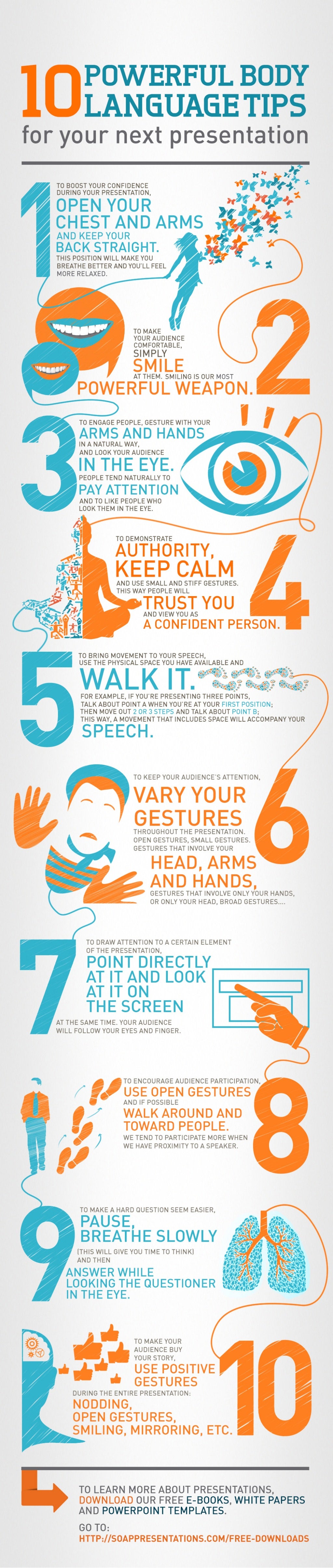
The following infographic can be found at this website. There are some very interesting insights into body language and speaking. We particularly like number 7 - point directly at and look at the screen. PowerPoints can be good or bad. We have talked extensively about death by bullet points. One way to overcome this is to interact with the text as you speak. This gives some creedence to those words and could go a long way to keeping attention and convey our message. With all these ideas we have to find what works for us. However we also need to try different things so we can refine our speaking skills but also we do not want to become predicable. Click here to see a larger version.


Monday, February 4, 2013

The Pravachan Jitters

Our scriptures note the particular significance of mantra-jap in its ability to steady our mind, yet the mantra of syllables we utter when nerves compromise our ability to communicate does anything but strengthen our resolve.

Photo Credit: andres.thor via Compfight cc

Stuttering stands to dilute a sticky message but can be reigned thanks to a few tips shared by an article on Duarte:
  1. Visualize Something Positive. Visualizing something that makes you happy is known to help you relax and thereby reduce stuttering. Imagine something that you love is in the room with you, or even keep a picture of something you love on the podium, or in your pocket. I’ve seen great speakers keep images of their children on their teleprompter because of this technique.
  2. Get Familiar. To this day, I visit a venue a few days before a show. I’ll soak in the details and reduce future distractions that can cause my mind to wander. I don’t know if it’s ADD, but I get those “Ooh shiny object!” moments when performing, and I seem to stutter after those distractions occur. So I try to familiarize myself with my surroundings, and if possible, rehearse in the venue so that it becomes second nature. This familiarity reduces heart rate and irregular breathing which are muscular triggers that can lead to stuttering.
  3. Rehearse, Rehearse, Rehearse. My professor used to tell us to rehearse our lines in a dark, quiet room, laying on our backs. This forces you to focus only on your voice and what you’re saying. Sometimes when I present, I’ll wear earplugs so that I can hear my voice, and focus on my projection and articulation. Perhaps you can’t memorize your whole presentation, but I would suggest rehearsing your opening and closing with this technique.
  4. Take a Deep Breath, or a Lot of Them. Before you go on stage, focus on the pace of your breathing until you can slow it down and reduce your heart rate. Once I get a controlled rate of breathing, I try to be conscious of it when I’m on stage. If not, the adrenaline kicks in, my heart races, and I talk so fast that no one can understand me.
  5. Pace Yourself. I mean actually pace – move around a bit onstage. A slow, steady walk across the stage can set a rhythm, that will help slow down your thinking and your speech, and reduce the confusion that often leads to stuttering. My instructor once made me recite four pages of a play while walking around the campus with her. I didn’t stutter once! But when I stood still on a stage in front of a large group, I stuttered and mumbled like a madman. The pace of my walking helped control the mechanics of it all.
  6. Get Some Sleep. For a long time, I tried cramming lines and content up the last minute of the performance. Staying up all night rehearsing and memorizing. I was a wreck. My professor told me, “Rehearse and study, but the night before, sleep, a lot!”
Let's face it, nobody likes to panic before a pravachan, but when we introspect, we realize the angst stems from whether or not we will defy the audience's expectations.

Ambition - now that's something worth contemplation.

Monday, December 24, 2012

5 Things Every Presenter Needs To Know About People

One common presenting tip is to “know your audience,” but what exactly should we know about them? While we may present to many different people (bal/kishore/yuvak/vadhil), here is an universal list of 5 things that every presenter should know about his or her audience.

Please be seated
People learn best in 20 minute chunks.
TED talks. That’s right, we’re referencing it again. If you take a look at TED talks, they are around 20 minutes long, and that’s part of the reason why they are so captivating. It shouldn’t come as a surprise that shorter is better since a shorter presentation forces the talk to be more concise and focused. However, don’t get stuck on the notion that every presentation must be 20 minutes to be good. For example, many times in sabha, presentations are planned to be more than 20 minutes long. The ideal presentation length is exactly the number of minutes it takes for you to get your simple statement across, not a second more. In order to incorporate this study, however, it would be idea to try to build in some kind of change every 20 minutes. Especially in bal/balika sabha, it’s important to give the kids a break from all the information they just received. This could be a great way to incorporate an activity/exercise that relates to the session. 

Multiple sensory channels compete.
When you are giving a speech, there are two sensory channels that are the most active: visual and auditory. According to Dr. Susan Weinschenk, our visual channel is stronger than our auditory channel. Therefore, if your presentation has complicated information for people to digest, then it will be hard to balance the auditory channel while trying to decipher what your visual aid says. A common tip is to put together a presentation without using any slides first and then decide if it can be enhanced with a visual medium. 

What you say is only part of your message.
Research in psychology over the last few decades has revealed that people process information unconsciously. People not only react to your message, but they also take into account your facial expression, voice, stand, and even hand movements. Think about how you are saying what you are saying. 

If you want people to act, you have to call them to action.
Be very specific about what you want audience to do. This is where the simple statement comes into play. It’s always a good habit to go over the main points of your presentation at the end as a call for action.

People imitate your emotions and feel your feelings.
When you are passionate about your topic, your audience will be passionate. People like to listen to someone who is animated, and passionate about a topic. Even if you are not so interested in a particular sabha topic, pretend like you are, and the message will go a long way. For example, in bal/balika sabha, it may require you to be more animated than usual in order to keep the balaks & balikas attention in a certain topic.

Friday, July 27, 2012

Presentation #FAIL

Nancy Duarte shares with us this reenactment of a talk doomed to fail. Though the points numbered many, the following caught our attention.

"Mediocre icebreak joke"
"Poignant quote from unknown philosopher to kick off presentation in dramatic fashion"
"Juvenile slide transitions to spice things up"
"Unexpected technical difficulty"
"Going through a long list of facts one by one by one"


To see it from the audience's perspective gives us the empathic connection needed together to put together a presentation worthy of honor. 

Friday, July 13, 2012

Saturday, June 30, 2012

Seize the Shibir

Green Day Concert Crowd - Put Your Hands Up For Green Day


Bill Clinton, Lady Gaga, and Chris Rock all have one thing in common - they know how to work a crowd, and we can too at a shibir or a convention! 

Sure, it’s a larger audience, but to be an effective shibir speaker, we will have to do a few things different from what we already do on a Sunday-to-Sunday basis. Aside from a larger audience, we have a new setting, a new microphone, and new faces in the crowd.

As always, we will need to do our SUS in order to to give our talk meaning, but an article at Lifehacker gave us a few more pointers:

Know Your Environment: Presentations always start with knowing the environment. How many people will be there? Am I presenting to K1, K2, Kindergarteners, or 8th graders? Will I have a screen? Remember, you, the presenter, are responsible for getting the message across to the audience. Therefore, don’t be afraid to make a simple request in order to make your presentation flow smoothly.

Body Language: Every Sunday, we have the chance to have one-to-one eye contact with every single person in the room. When talking to a bigger crowd, eye contact is still important though much harder. Therefore, we have to be strategic. Break down the audience into different blocks, and work with each of the blocks one at a time. Imagining the audience as a huge mass will make it harder for you to develop a connection with your crowd.

Keep it Simple: Try to avoid using a large amount of special effects in the presentation. Don’t sacrifice clarity for animations, sounds, and/or background images. Even if we’re using PowerPoint, it’s best to keep the slides straightforward and clean.

Interactivity: Without being a afternoon talk-show host, there are certainly ways that we can connect with our audience at shibirs. Because there is a large audience, things might get tricky when we’re trying to get interactive, but we can always create exercises to make it happen by asking the audience to do any of the following.
  • "Turn to the person on your left and talk about..."
  • "Write 3 things on your sticky note that..."
  • "Raise your hand if..."
  • "Rub your tummy, stomp your feet, etc." (for bal mandal of course)
Getting out from behind the podium is also another way to connect with the audience as well as getting a wireless mic to ask the audience questions to get interaction. Of course, we would be wise to avoid frivolous inquiry like, "Who is the President?" "What is agna?" "Who can define raajipo?" 


All in all, a shibir talk just requires a modified approach that would not be possible without the basic understanding of a Sunday talk, for only after captivating a sabha audience can we hope to hold a shibir audience. 

Sunday, June 24, 2012

Know your Audience - But first get feedback

Many centers had graduation sabha this weekend. We had one. We were asked to give a small 10 minute keynote talk. Awesome. We fired up the SUS engine and also were sent a link to a great commencement talk that has been making its way across the internet. The entire video is embedded below. In it English teacher David McCullough makes the audacious statement to the audience that they are not special. He was looking at the entitlement attitude that pervades high school

His best quote two quotes:

You see, if everyone is special, then no one is.  If everyone gets a trophy, trophies become meaningless.

The fulfilling life, the distinctive life, the relevant life, is an achievement, not something that will fall into your lap because you're a nice person or mommy ordered it from the caterer.  


So we read all this and we felt we were set.

Simple: Graduation is the start of trying to become special, even though we are not right now.
Unexpected: Telling all the graduate that they are not special.
Stories: We had a few prasangs that fit the bill.

We gave the talk.

A few people told us - That was a great talk.

Then we asked our board of people who we trust to give feedback. And one person gave us a gem.
"You started off great, but then you went to the you are not special part. I see where you were going with that. It definitely engaged the older kids. There were many shishu and small bal/balikas. When you tell them they are not special, they can really take it the wrong the way."

Think about your audience. We have mentioned it so many times before. But this time we simply forgot about it. A very good learning point. We hope we don't forget it again.

Tuesday, May 29, 2012

One minute SUS Example

If you have a minute (literally) you should watch this talk. We talked about Wadsworth Constant. You can remove a great deal of our matter and still make our point stick. The talk below is a great example. Simple message, unexpected using the rocks, and a great story. Also Rosling's is passionate about the subject - that always helps. Could you do this same thing with your Sunday talk? It would make for a very quick - yet sticky - sabha.


Friday, February 3, 2012

Simple - I know it when I see it.

We have been working with some balaks on speaking skills with a focus on simple, unexpected, and stories. It was interesting that the balaks seem to get tripped up on simple (the other two the get right away). What do you mean by simple? It turns out that this is a really deep questions. In Made To Stick there was a large section  of the book that explored this idea. I keep coming back to the notion that you know simple when you see it. For example:

The iPhone interface is simple (but not simplistic).

Today (2/3/2012) is a good day to check out the following simple (but not simplistic) website.

In both these examples the purpose is clearly defined and the interface reflects exactly that. In giving our talks we must first really understand the material and then synthesize what message we want to convey. This takes time and most people skip this step. However it is time well spent since it is really understanding what you want to say that enable you to say things elegantly. 

Wednesday, February 1, 2012

Unconventional Advice

Every so often, we stumble upon some unorthodoxy that has the potential to shake up our speaking for the better, like this recent LifeHacker article.

    All I want for Christmas is a 2 dimensional reduction
  • Dribble Twice, Spin Once: Basketball fans will recognize the pre-shot patterns of basketball players to better focus themselves. Preceding our presentation, a similar routine can help shake some nerves and build confidence.
  • Death to Powerpoint: Slides often stymie our natural ability to express ourselves, so use Powerpoint with discretion.
  • Speak to Two People: Eye contact can rattle the new speaker, but focusing on two people in the room keeps things in perspective.
  • Embace Your Ums: Focus on your natural storytelling ability, and the audience will seemingly gloss over those pesky words.
  • Don't Memorize: Rehearsing can help us develop our flow, but memorization just renders us mechanical and inorganic.
  • Practice with Live Ammunition: Set yourself to speak publicly to capture a true simulation. With practice, we can feel accustomed to this arena and excel.
Twist things up with these tidbits of advice, and let us know how they end up working out!

Tuesday, January 17, 2012

Shyness is I-ness

What causes us to be shy in speaking? What causes us to be nervous before we give a talk? 

Mark Harrison shares the following idea:

Shyness is pride
Someone I respect a great deal once told me that ‘shyness is pride.’ What he meant was that shy people spend too much time worrying about themselves and how they look in the eyes of other people, when they should be focusing on what’s outside, trying to do a good job, trying to add value to the situation. This is brilliant advice – start thinking about others and less about yourself. In fact, everyone else is actually thinking about themselves, too. Nobody really cares about you. So stop being so self absorbed.


The idea is that we all have pride. The more we put ourselves outside our comfort zone, make mistakes in front of others, learn to take constructive feedback - the less ego we have. This resonates with a great deal that we have seen. Many times at the Mandir we will give constructive feedback to all age groups. We find the younger the age group the more apt they are to really receive this feedback and improve on it. When we talk with shishu aged kids, it is quite easy to work with them to be better presenters. Although they are getting feedback (or rules) all the time, it is amazing to see how readily they can internalize this feedback as long as it is explained to them so that they can digest it. The older we get and the older the speaker we talk to, feedback needs to become subtle as egos tend to get bruised more readily. Yogi Bapa showed a way around this by becoming a friend first (het karva shikvu), so giving this feedback takes time - maybe many years. 


Speaking is also a double edge sword. Shyness in speaking is due to pride, but a very good speaker can easily develop ego in their speaking skills. So as we all become better speakers it is a good idea to take a moment and realize that we are doing this for Maharaj and Swami, and it is really their krupa that enables us to become better. That grounding thought should overcome our shyness/pride in trying to speak and deter our arrogance/ego when we become a good speaker and enable life long feedback to become as easy as a shishu

Friday, January 13, 2012

Stop Reading

Seth Godin shares this insight in his blog. It is dead on when giving a talk. Last week we mentioned finding your voice by listening to great story tellers. Godin takes the counter example.


Your voice will give you away

It's extremely difficult to read a speech and sound as if you mean it.
For most of us, when reading, posture changes, the throat tightens and people can tell. Reading is different from speaking, and a different sort of attention is paid.
Before you give a speech, then, you must do one of two things if your goal is to persuade:
Learn to read the same way you speak (unlikely)
or, learn to speak without reading. Learn your message well enough that you can communicate it without reading it. We want your humanity.
If you can't do that, don't bother giving a speech. Just send everyone a memo and save time and stress for all concerned.

Thursday, January 5, 2012

Your Own Voice

Telling a great story is one clear way to keep your sabha engaged. There is something that happens when you tell a story live (and without notes) that if done correctly can capture an audience (or put them to sleep if done not so correctly). One of the best ways to tell a better story is to simply listen to as many good stories and story tellers as you can. 


At the (newly redesigned) BAPS website there are many recording of P. Santo telling stories. "Wait this is katha!" you might say. Yes but at the heart of katha is a series of stories. Here are some examples:
One key to telling a great story is to tell your story. Repeating something we heard in katha is great, but when we say it in our own voice, with our own observations - that story then comes to life. Below are a few story telling podcasts that can give examples of exactly that. Many of these are done very well, while others can be hit or miss. However they give a different way of telling a story which we can use when telling our story. So try listening to katha and using some of the techniques you enjoy in the podcasts below and telling the story in your own voice.
  • This American Life. Everyday stories told with a definite cadence. These are very sticky stories. Even when you seem to not care about the topic, they find a way to get you interested. Many sticky techniques on display.
  • Radiolab. Where life meets science meets audio. While the audio plays a major part in this podcast. Telling science stories from the view of a person who does not understand science works really well for telling prasangs to Bal/Balika/Kishore/Kishori mandal.
  • The Moth. True stories told live on stage without notes. We love the Moth. To understand why google Moth Adam Gopnik LOL and have a listen. These stories range all over the place and are not always amazing. But still there is something to learn (and be entertained) in nearly every episode.
  • The Story Collider. Similar to The Moth but the stories are about science. This is a recent find and the stories have been consistently good. 
  • Freakonomics. The hidden side of everything. This podcast is interesting because the story telling revolves around economics in everyday life. This really helps with making prasangs concrete.
  • Intelligence Squared. Debates. These are rebroadcasts of live debates where there are winner and losers. The audience is polled before and after and the side the changes the most votes wins. This really highlights how to give a convincing talk, how to frame your ideas. 
  • Planet Money. Similar to Freakonomics, more like reporting than storytelling.
  • Snap Judgement. Urban story telling. A great deal of international stories as well. Good place to pick up idea on how music, cadence can add to story telling. 
  • 99% Invisible. The story telling of design. We find this podcast is great at taking mundane objects and ideas (things we tend to overlook) and see them in another point of view. Can give good ideas on how to make prasangs and satsang concepts relevant.
  • Transom. This is a new one we are listening to. A few of these stories made it to This American Life.
  • Third Coast International Audio Festival. Similar to Transom.
Update from fellow Sabha.ologists
  • The Monti. Unscripted and Real. Some of these are better than The Moth. 
This list is by no means complete. We would really like to know your recommendations.