Saturday, December 14, 2013

What's the best way to give feedback?

That is the question David Rock explores in his book Your Brain at Work: Strategies for Overcoming Distractions, Regaining Focus, and Working Smarter All Day Long.  This is a great counterpart to our previous post on feedback.  Here we mentioned that people may get angry or upset with feedback. We see this sometimes during sabha review. So instead of the compliment sandwich what if we try being the coach. From the book:

The source of the difficulty here lies in who comes up with the solution. Paul’s suggestion makes him look smarter, and Eric less smart. This impacts their relative status, which Eric is likely to fight against. The better Paul’s answer is, the more likely Eric might resist it. It’s bizarre… Paul’s giving out suggestions also threatens Eric’s autonomy: it’s no longer Eric’s choice to follow a specific path.
So how do you get around this? Don’t give a solution, ask questions and have Eric come up with the answer himself.
Eric isn’t going to take action until he has an idea that fits with his own thinking. In his current over-aroused state, he quickly rejects external ideas. Given that Eric is at an impasse, Paul needs to help him find an insight to solve this problem. If Paul can’t make direct suggestions, why can’t he just give Eric some clues about what to think about, perhaps posing a good suggestion as a question?
If you merely guide with questions, but they come up with the solution themselves, they’re less likely to feel threatened and more likely to follow through:
Instead of your looking for a gap in the form of the source of another person’s problem, the other person is finding a gap in his own thinking process. It’s not you searching for problems; it’s him searching for gaps in his thinking process. You want people to look for assumptions or decisions that don’t make sense upon further reflection.
The more you can help people find their own insights, the easier it will be to help others be effective, even when someone has lost the plot on an important project. Bringing other people to insight means letting go of “constructive performance feedback,” and replacing it with “facilitating positive change.” Instead of thinking about people’s problems and giving feedback or making suggestions, change can be facilitated faster in many instances if you think about people’s thinking, and help others think about their own thinking better. However, letting go of the default approach to problem-solving requires working against the way your brain wants to go.
When done correctly this is how sabha review should really work. The proverbial teaching someone to farm instead of giving them food. As all of us who have tried to do a sabha review understand full well - this is easier said than done. It really takes time and practice to do feedback well. If you sabha review is going well, you may want to just talk with the main speaker or work with the sabha sanchalak to practice this ask many question approach to feedback.

Wednesday, December 11, 2013

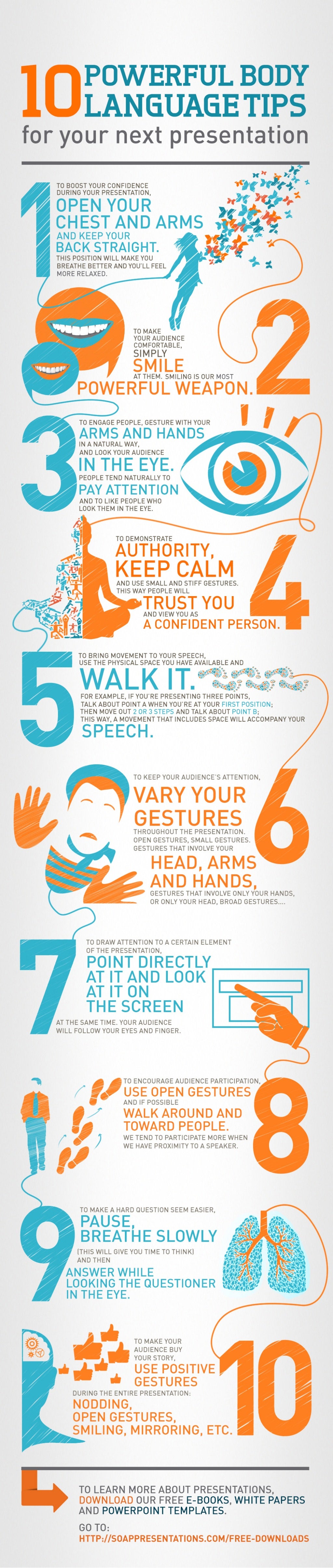
Body Language

The following infographic can be found at this website. There are some very interesting insights into body language and speaking. We particularly like number 7 - point directly at and look at the screen. PowerPoints can be good or bad. We have talked extensively about death by bullet points. One way to overcome this is to interact with the text as you speak. This gives some creedence to those words and could go a long way to keeping attention and convey our message. With all these ideas we have to find what works for us. However we also need to try different things so we can refine our speaking skills but also we do not want to become predicable. Click here to see a larger version.


Tuesday, December 3, 2013

Feedback

Becoming better at speaking takes practice. However thoughtful practice enables us to improve much faster. This is why we have coaches in sports. They figure out where we need the most help and focus our attention there. They also help us accentuate our strengths. So getting better at giving a sticky talk involves first giving as many talks as we can - just putting ourselves out there. To improve rapidly involves having a coach (or a mentor) give us feedback.

Feedback is a wonderful tool if done correctly. If we are not harsh about it, point out positives as well as areas of improvement, and give specific examples of what to do better and why, feedback can work wonders. This is why many centers conduct sabha review. It is a chance to get better. The mood should be congenial and be one of learning and helping.

Feedback done incorrectly can be insufferable. We have all sat through feedback sessions where each person gives their version of the following feedback: "The talk was good." The small positive here is that it goes fast and the person who gave the talk does not feel bad. Even worse is the feedback where the person can't wait to list all the things the speaker did incorrectly. This takes for ever and the person who gave the talk usually never wants to give a talk again.

P. Santo give us guidance on giving feedback. They mention to praise the person. "You did good." This phrase has good intentions, but rings hollow. Specific praise works better. "When  you incorporated a personal prasang in your talk it really moved me and drove home the point you were making." That is much better praise - it is more heart-felt. It is specific. We can use the SUS paradigm from Made to Stick to give feedback. Comment on how well the person got their simple message across. When telling someone where to improve it is best to choose one or maybe two items that the person should focus on. Giving a laundry list will not help them and may deflate them.

Tim Harford gives a great example of this on his blog. It is exerted here:
 ‘Feedback is standard in certain environments … But it is rare for criticism to be quite so practical’
I recently gave a talk at a large venue to nearly 1,000 people. It seemed to go well but who am I to judge? The experience of giving a speech is radically different from the experience of listening to one. An adrenalin-drenched emotional rollercoaster for a nervous speaker may nevertheless be unbearably tedious for the listeners. A superbly honed performance may produce a sense of suspense, surprise and delight for the audience; the result of many hours of rehearsal and repetition for the speaker. Yet it can be very hard indeed for the speaker to know what worked and what didn’t.
Audience comments aren’t much help, either. People are polite, and they know that giving a speech is difficult, so a handshake and a “well done” could mean anything from “you moved me to tears” to “you bored me to tears”. A speaker can float through talk after talk in a warm bath of gently encouraging remarks.
On this particular day, though, I was in for less of a warm bath, more of a bracing shower. The Geoffrey Boycott of personal financial advisers was in the audience – a tall Yorkshireman with lots of unvarnished opinions that he felt duty-bound to share with me in the lobby afterwards.
“For a start, I kept wanting to offer you my tie. Next time, wear one. And your shoes – I notice things like that.” He gestured towards my evidently slightly-too-comfortable footwear.
“But that’s not what I wanted to tell you,” he continued. I waited, a little bemused. “Your first slide, instead of just telling us that it was John Maynard Keynes, you could have asked, ‘Does anyone know who this is? Anyone?’ It just gets your audience a bit more involved. I teach public speaking, you see.”
I nodded and thanked him for the suggestion but the flow of comments was relentless. “Don’t get me wrong, I liked it. But then, what you could have done was … ”
As a piece of rhetorical advice, it was too much “public speaking for beginners” to take entirely seriously. But the conversation was an absolute masterclass in how to give feedback: arresting, friendly, frank – and above all specific. My self-appointed speaking coach had identified a set of particular points he wanted done differently, and listed them clearly, with reasons, examples and the occasional word of encouragement.
Such feedback is standard in certain environments – Olympic coaches, editors on deadline and schoolteachers all provide focused constructive feedback if they’re any good. But it is rare for criticism to be quite so practical: it’s usually vague and verging on flattery or cruelty.
An alternative is the “praise sandwich”, a thin but chewy sliver of specific feedback, squeezed between two thick, doughy slabs of praise. This seems like a common sense way to combine criticism with kindness but it is not always helpful. The economist Richard Thaler once posited the idea that we practise “hedonic editing” – lumping together good and bad news to make ourselves feel better. (An example: why fret that I lost my wallet, when my house gained thousands of pounds in value just this month?) Hedonic editing allows us to take the rough with the smooth; but that makes it a dangerous way to process critical comments. It helps us feel better but it doesn’t help us perform better.
Yet there’s no use blaming the critics for being too vague: they’re vague because they know that specific criticism is not always welcome. I have taken to seeking out specific suggestions for improvement, when I can muster the courage.
It’s draining to ask for such comments. It is also difficult to provide them: if you ask people to think hard about something you should have done differently, they will often be lost for words. But there are certain, glorious exceptions. If they don’t buttonhole you in the lobby, they’re worth seeking out.