We just reviewed (literally) a few of the past posts on commencement talks. Which got us to thinking about really great commencement talks. Here are a few. Read Guy Kawasaki's talk - it does not get any stickier.
We really, really like this form of sticky talks. (We have been to our share of them - good, bad, ugly). Let's us know if you have one that needs to be on this list.
There things we really look forward to: TED Talks, This American Life, Mind Magazine, and now Current TV. We enjoy these things because well they are sticky, they give us ideas we can use in sabha, and they make us smile. We like smiling. Check out this video - this would be a great way to start ANY sabha - especially for a joint sabha of all ages. This can tie into Ek Parivaar, samp, ekta, working together, vasudev kutumbhakaran - we are all one family. Watch the video and join the family. Do you think you could use this in sabha? Let us know.
Seth Godin is a namesake on this blog, and a fellow sticky presenter brought to our attention that he's got something new as 2009 comes to a close.
Hey guys,
Jai Swaminarayan! You may know how much I like Seth Godin's stuff, he is a mover and shaker. He just put out a new e-book that really goes over a lot of the things we've started conversations about...
Here is an excerpt:
Speaking soon? Keep this in mind: people at events are hungry for authenticity. Saying something you might not have said elsewhere is a good way to find your authentic voice.
For my own conference, I often give advice to speakers before they come on stage. Here’s an exercise for anyone who wants to connect with an audience.
A few weeks before the event, when you start preparing the talk, write out everything you spend your time doing - professional work, side projects at home, everything.
Now pick the one thing you’re most excited about.
Now consider: why is that so important to you?
Design your talk from that point, as if you started by saying, “My name is X, and I’m passionate about XYZ because...”
The rest of your talk should fall into place easily enough. Yes, it’s important to know your audience, use A/V materials wisely, watch your time, and so on. But you have to build the talk around your passion.
Here’s the final measure of your success as a speaker: Did you change something? Are attendees leaving with a new idea, some new inspiration, perhaps a renewed commitment to their work or to the world?
Be honest, be authentic, and speak from your passion. Yes, it means taking a risk. But the results might surprise you.
Mark Hurst runs Gel and founded Creative Good, a customer experience consultancy.
This does not do this eBook justice, it is REALLY good. You can read one page in about four minutes!
While some principles are universal, some aren't when it comes to pinpointing the traits of an effective speaker/presenter. Jessica Cam Wong noted five:
Engage your audience
Get to know your audience
Stay positive
Be concise
Give your work a captivating title
That picture got you itching for more? Read the article in full below.
The writer Oscar Wilde once said, "True friends stab you in the front." When it comes to speaking, feedback is integral to our improvement, but figuring out how to collect that information is a task in itself.
To help us out is Lone Gunman's Lloyd Morgan's post below.
As 2009 rolls to a close we have a few more weeks to make an amazing talk in any sabha. We had set the goal of doing 10 amazing talks in 2009. With the time remaining let's try to make one more amazing talk before 2009 comes to an end.
We thought it would befit us to end on a bit of a challenge - which of the following talks is the most stickiest?
Our first challenger, Shashi Tharoor, hails from the TED India Conference held in November. You may not agree with his thesis, but you will notice that talk is enjoyable. He is essentially following the SUCCES steps to making a sticky talk; he's entertaining.
Simple: India is gaining soft power.
Unexpected: His examples (more cell phones in India / per month are sold than anywhere in the world).
Credible: Examples back up the stats
Concrete: Stats paint a picture that backs up his main idea.
Emotion: Though his weakest point, it comes through how and what he says.
Stories: MOST importantly, he is telling story after story.
Contestant #2 is also from the same conference. He's Nandan Nilekani and speaks about India's future. A fellow presenter mentions to us - "would like to comment that [Shashi Tharoor's] talk is a bit sugary and could have been better if there were substantial numbers to convince people. I would [reply with Nilekani's] talk."
Another great post from one of our sticky presenters - a Canadian no less!
As 2009 draws to a close, most of us are thinking about ways to improve in 2010; especially in the context of project marketing. Below is a link for a talk given by Rory Sutherland asserting that a change in perceived value can be just as satisfying as what we consider 'real' value. It may sound manipulative when put as such, but he speaks on topics, such as rebranding, that I think are valuable and valid in our current discussions.
Hope you find it thought provoking and inspiring in your planning, if nothing else, the last example provides a good laugh [and that's coming from a Canadian :)].
Macs, iPods, iPhones - Apple has left its mark in the products we buy and so has Steve Jobs. Take a look at this slideshow by Carmine Gallo who analyzes what makes this guy so powerful.
Shalu Wasu's article tackles the age-old issue of sprucing up Powerpoint.
Here's a snippet - how do the great model their Powerpoints? As we can see, the styles vary dramatically.
Lawrence Lessig: He is a monster slider! He can use up to 200 slides for a 10 minute presentation and he makes them really good.
Seth Godin: He follows a style which has a lot of visuals, little text and likes to surprise the audience.
Guy Kawasaki: 10 slides, 10 ideas, one idea per slide, not more than 20 minutes.
Takahashi: Super size font sizes (more than 120) and obviously very little text
The last point?
Do not stick to your story. Make the story sticky. Try to follow at least 4 out of the 6 essentials that Chip and Dan Heath talk about in their book Made to Stick. Here is a quick summary.
A common presentation tactic is to use the handy dandy Powerpoint. Who can beat those seamless slide transitions with words and pictures flying onto our slides?
To juice up our presentations, take a look at this post by CC Holland.
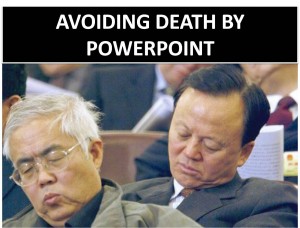
Oh, you want me to join your meeting for a quick info download? Great. Don’t forget to tell me to build a PowerPoint presentation.
Instead of letting me speak to the group for three minutes to explain the new initiative, make me present a slide deck. With bullet points. And, preferably, with cutesy little graphics. Bonus points for animated slides.
Make sure we take time to futz with the A/V setup, pull the blinds, and make sure everyone in the room has a good sightline. Burn a little time by making me stand up in front of the group and assigning some random person to click through my presentation for me.
By all means, have me read verbatim from the PowerPoint slides. After all, it would be heresy for me to be spontaneous, natural, or (God forbid) collaborative with my audience.
Remind me to make 14 hard copies of the slide deck to pass out at the conclusion of my talk, which has now taken 20 minutes instead of the anticipated three. Why? Because no one was paying attention to the presentation anyway, so they might want to read it later.
Also, it makes people feel important to walk away from a meeting with a sheaf of paper. Let’s not worry about the trees or the company’s “Go Green!” initiatives.
And above all, never mind that it took me a grand total of two hours — building the slide deck, making copies, and presenting — to convey information that, again, should’ve taken three minutes, max.
What a great use of my time and a fabulous way to boost my productivity! The corporate reliance on PowerPoint for all purposes is clearly a wonderful, wonderful thing.
"What we achieve inwardly will change outer reality." - Plutarch
We all know her as the talented and prolific writer behind the Harry Potter series, but J.K. Rowling really packs a punch in this commencement speech given to the Harvard Alumni Association. She talks about the advantages of failing along with the power of creativity as reflected by her life experiences since graduating college.
This speech can be used at any karyakar meeting and even sabhas. Let us know how it worked for you!
If all the lectures at Harvard are this good, I really wished I would have done better in high school. Listen to this just the first 15 minutes of this and there is no way a sticky presenter will not smile. This has many implications for sabha topics: karma, why do bad things happen to good people, sarva karta, prarabhda, free choice.
More importantly notice how well he is working the room with questions. This is really key. Many times in a sabha that misses the presenter resorts to questions - but he/she already has an answer, he/she does not want to explore. For example, the presenter might say "Who is the President of the United States?" That question serves no purpose other than to ensure that one person is paying attention. Another question would be "What is Karma?" Again this is not a great question since there is an answer that you are looking for and if someone strays from that answer you have to scramble to push back in the flow of your presentation. The questions being asked here are AWESOME. They are thought out. There is no one answer. He uses the questions to start with something unexpected and to get the audience to think.
He is also very encouraging to anyone who answers. He is not intimidating. He is free with praise for any answer. Depending on the audience and the speaker this is a valuable lesson.
Watch this, 15 minutes, it will make you smile. If you want more episodes, be sure to check out the site.
A fellow sticky presenter used the SUCCES method to make a shibir talk stiky. Here is his take on the process.
"So I had to do this talk a few months back on balancing Satsang and education. Thanks to some presentation hits and misses, I knew the first thing I had to do was think of the audience -- K2 kishores. K2 kishores are very different from K1 kishores. I can play a red-light-green-light game with K1 kishores and they'll be satisfied. K2 kishores like to be treated as adults and they like to be talked to as adults. I've generally found discussion-based learning to be more effective with K2, but that wasn't an option for a general talk like the one I was to give.
I decided that the best way to get their attention was to push the envelope. I wanted to "get noticed" by the audience, so within the first two minutes I shared some ridiculous goals I had set as a kishore in high school after a priority-setting presentation done by a yuvak, which included going to Harvard or Stanford, becoming an international man of mystery, marrying a pretty girl, and benching 300 lbs. These initial goals ended up sticking with the audience really well, and also got a lot of laughs. They were bought in by then.
The rest of my presentation relied on pathos and self-reflection. I incorporated A LOT of personal stories that I knew would resonate with everyone. I even talked about girls (carefully, of course) -- I figured it would have offended the kishores more if I pretended that this wasn't a big deal. This too ended up being sticky (unexpected).
I decided on a very simple, image-driven slideshow to accompany my talk. My last slide had three takeaways -- if they didn't pay attention to any of my presentation, those three points could sum it up well enough. I also had an easy-to-understand venn diagram to support a few of my points.
I think the most important thing I did in the talk was play on their emotions by doing two things. First, I took time to explain to them how their friends might be making them feel guilty about doing Satsang. Many kishores came up to me to talk about this point after the presentation, unsolicited. I also ended with some lines from an email sent by a sadhak about buying into Satsang (many people may have seen it already).
This write-up really doesn't do justice to the format and delivery of the content. But I did look back at the book and realized that I had inadvertently made this talk sticky -- it was simple, unexpected, emotional, credible, concrete and filled with personal stories. And if I were to work backward and apply this model to every talk, this is what I would do:
1. Come up with the takeaways (no more than three) 2. Find a lot of stories around those takeaways, some that push the envelope or really encourage reflection 3. Make sure you have a strong, attention-grabbing introduction
The rest of the sticky points just fall in place. I tried this for a karyakar goshti and it went really well too, even though I wasn't doing all of the talking."
Have you given any sticky talks lately? Let us know so we can share our SUCCES-es.
While the year and the decade is ending, it seems that we have to validate or negate those new ideas we rolled out over the course of the year. Number crunching may be no fun, but reading the results doesn't have to be.
The Heath brothers, authors of Made to Stick, write,
A good statistic is one that aids a decision or shapes an opinion. For a stat to do either of those, it must be dragged within the everyday. That's your job -- to do the dragging. In our world of billions and trillions, that can be a lot of manual labor. But it's worth it: A number people can grasp is a number that can make a difference.
I stumbled upon this presentation by Ferrazzi - he wrote Never Eat Alone, a book my cousin gave me that exemplifies the power of networking (when done with heart). It maybe be useful to you as well. He takes the next step in this presentation focusing on what Gunatitanand Swami said - to remain strong in satsang one needs to keep the strong attachment with two sadhus and two satsangis - it is essentially a Lifeline Relationship. P. Mahant Swami use the same idea when he talks about mountain climbers tying ropes to each other to ensure that they do not fall.
Nice read. Useful for katha, presentations, or meetings. You may find it useful in seva, work, school.